Day 2: Playing with Refugees – ORIGINAL PLAY

Oct.7.2016

After breakfast , we headed to a school for Syrian refugee children in Beirut. A humble building with a 2-3 indoor classrooms and an outdoor area used for break-time and PE. In order to maximize on the limited space, the school operated in shifts.The children who came in the morning shift were different from those that came in the afternoon.They each attended school for 4 hours a day.

This slideshow requires JavaScript.

Upon arriving at the school and while waiting for the admin to show us in, one  of my team  members found a children’s story book written in Arabic and asked me to translate it.  I had never seen a children’s story book like this one before. The words and illustrations were of bombs, soldiers, underground hide-outs, and power outages. The book reflected a children’s version of the Lebanese 15 year civil war .

The back-ground or so called “play ground” was set in an outdoor open space intimately surrounded by apartment buildings with small balconies so that those who lived  in the apartments could and did poke their head out to see what the commotion below was all about. Some of the old building walls surrounding the play ground were dotted with bullet holes, not an uncommon sight in Beirut.

This slideshow requires JavaScript.

As the students trickled in they were disorganized, chaotic, and deaf to instructions.  I found myself turning into a policewoman, standing larger, and raising my voice.  Initially, it was impossible to play with the children as the team was basically breaking up fights instead and policing kids into order. The scene consisted of girls & boys of different ages running around hitting each other, kicking, pushing, and hair pulling . Every corner you looked some form of aggression was taking place. Boys were hitting girls, larger kids shoving the smaller ones, girls pulling each others hair and fighting with boys. When it was time to line up to go back to class, the teachers were being ignored and a lot of arguing and lingering around was flaming the fire even further. Fred said there was more aggression at this school than he had seen in a prison!

As the first group of kids left for the day and we recognized the new the kind of challenge on our hands this afternoon, I looked at Fred and thought to myself, “Where do we start?”. There was a serious behavior management issue  and the teachers had little control over the students. As if Fred heard my panicked thoughts, he used his firmest and calmest voice to tell the team to pack up the mats and leave no trace of our presence for the second group of children.

While having a short break and recharging for the next round, the team had the chance to sit with the principal and ask for some background on the kids. She said that most lived in a very confined space, sharing a small room with 5 or 6 others. Some of these children, even though older, had never done any formal schooling before. Some as young as 9 were working as car mechanics to help the family make ends meet.

One of the school bullies (in the green and white t-shirt) lived in a room with 6 other brothers and their father. The father sometimes put him out to spend the night on the street as punishment for bad behavior. He was about 11 or 12, wearing a white and a green striped t-shirt, and usually seen hitting and displaying territorial behavior around the play-ground . When it was time to play with the older boys, him and another verbally and physically aggressive boy were not listening and endlessly arguing with their teacher. One of them was shouting out curses and having a teenage temper tantrum.  Fred used his firmest and calmest voice. They could either go back to class or play according to set  boundaries. He repeated and I translated, we would not carry on until they made a decision.

This slideshow requires JavaScript.

To everyone’s surprise the boy with the green and white t-shirt decided to join us at the mats. He played. He respected our rules. When it was time for the inquiry, I asked:

  1. Did we hit you? (no)
  2. Did we kick you? (no)
  3. Did we hurt you? (no)

That is true play. We sometimes forget. Therefore, we need to remind ourselves, our friends, our parents & siblings, and our teachers that anything hurtful is not play. We must speak up for ourselves and others and say stop it!

The tough boy’s facial expression had softened and he shared with us that his father and brothers hit him and would do not listen to him.

I have to point out that he not only opened up to play but he also felt safe enough- in the play space- to express the truth of his harsh reality. After 20 minutes of Original Play, this bully had the willingness to share and be vulnerable in front of a group of strangers. He exchanged hand-shakes and manly hugs with the male members of the team. Wow, what a real transformation! I was so happy I witnessed that 🙂

I need to stress that some children who experience any kind of trauma or aggression in their daily life, may require a longer time to reach that stage of engagement, connection, and being emotionally open.

A change in facial expression. A response to a look. A loosened grip. A less guarded posture. The telling of one’s story. I understood what Fred had meant when he told us to look out for the small changes.

Rawan


Day 1: Playing with Refugees – ORIGINAL PLAY

Today marked a reunion with the amazing Original Play team!  Fred Donaldson, Noraini Mahmood, Soumaya Al Azem, and myself. The four of us had not met all together in Lebanon since my last trip to Beirut in 2014. The team had grown since and I was about to meet the rest over breakfast in our hotel restaurant. Ingrid, Sonia, Uwe, and  Armin!  The team was multi-culturally rich ( Germany, Austria, Sweden/USA, Bahrain/Singapore, Canada/Dubai). I would get to know the new participants and share some profound moments with all, over the next few days.

You are probably thinking what is this Original Play? What is she talking about?! I can start by telling you that is not something you can describe in words but can only experience first hand. The best I can do here is to describe it’s purpose.

The purpose of Original Play is to replace aggression with gentleness, isolation with connection, confusion with clarity, war with peace, and fear with love.

The founder of Original Play is the world renown play specialist  Dr. Fred Donaldson, a very inspiring individual who has dedicated his life’s work to changing patterns of fear and aggression around the world . He has taken this work beyond academia, cultural boundaries, and language. Fred is also a skillful martial artist and uses martial art principles in his work with refugee children, street kids, gangsters, prison-inmates, children with special needs, and wild animals . Yes, you heard me! He has practiced Original Play with wolves, horses, bears, lions, and dolphins.

I will leave the details of his story for you to find out, either by attending one of his introductory lectures, signing up for a weekend workshop, looking him up on google, or by having a chat with me. I have had the privilege of following Fred to several destinations as an apprentice in Original Play and have watched him do his magic in Bahrain, Poland, and Lebanon to name a few. This time I come from Dubai to spend 5 days with him and the team in Lebanon where we will spend our days mostly playing and interacting with refugee children and their families. The next few blog posts will document each of the five unforgettable days so please stay posted!

Oct 6.2016

After a hotel breakfast, the eight of us along with the two drivers headed towards Tripoli to the psychological center for trauma relief which hosts Syrian refugee children and their mothers (as most of the fathers have either been imprisoned or tortured to death).

14731129_10154704742937728_3460154034076893890_n

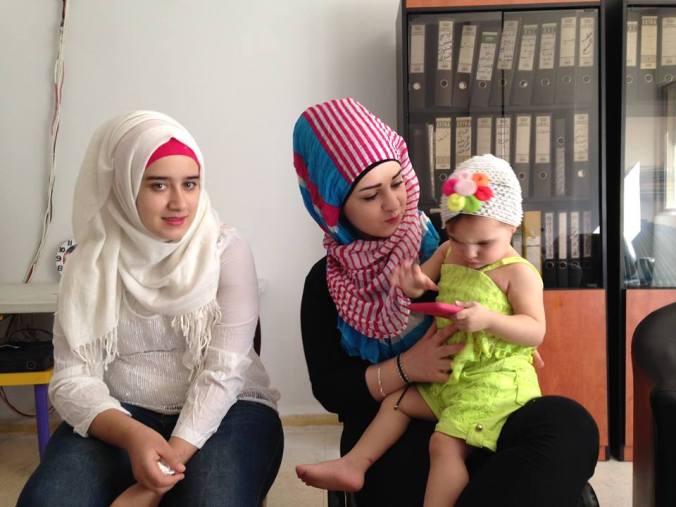
These two young teenagers with their niece told us of their struggle to survive in a dangerous area in Tripoli, at risk of being harassed or raped, the 16 year old was forced to quit working at an ice-cream shop. After both the dad and brother were kidnapped and killed in Syria, the remaining family of four women fled to Lebanon. The girls now out of school and desperate to make ends meet. A 14 year old, a 16 year old, a 23 year old (not in the picture), a toddler, and the mother (not in picture). The oldest one, abandoned by a new husband after giving birth, works a 12 hour job as a hairdresser in Beirut and leaves her toddler with her teenage sisters. Her salary is just enough to cover the rent for the small room they all stay in. Her salary does not cover food or transport for the long journey from Tripoli to Beirut and back. Donations collected by one of our team members  would help move them to a better area and fund their education for a year.

At the center we played with 2 groups of children in a small classroom. Afterwards we headed towards 2 orphanages. I was assigned the role of translator since I was Arabic speaking. I introduced the team, explained the reason behind our visit, and the rules of Original Play. At the end of the Original Play session I always asked/translated to the children the same 3 questions and got the same answers.

1. When we played with you did we hit you? No

2. Did we kick you? No

3. Did we hurt you? No

That is what real play is. It is when everyone plays together safely.There is no winner or loser. People can be older or younger than us, parents or siblings, or people from different countries. Yet, we can all play together safely without any body getting hurt. Anything else is not play and we must say stop it! This is not play, I will not participate.

I need to stress that this is incredibly important for kids who have experienced trauma and hardship, which in turn breeds hopelessness, frustration, and subsequent aggression. When families are in survival mode the fight or flight response is activated – you either become aggressor or victim, there is no in between. We see this manifest in many circumstances such as slums, street gangs, …..and refugee camps.

This slideshow requires JavaScript.

Before continuing our journey we stopped in the old market in Tripoli for lunch in an old Lebanese restaurant and some soap shopping which Tripoli is famous for.

At one of the orphanages. After laying out the mats, we played with 5 groups of children, starting with youngest and most gentle (often but not always the case).  While playing with one of the last groups of older more aggressive males, 3 boys jumped on one of my male colleagues’ back and while trying to get one of them off I was pushed hard and fell. No harm done, but that day I learned that I could get hurt doing this and needed to be okay with that. I also learned a lesson in leading the play, when one of the boys had a choking grip on a colleague and it was my responsibility to know when to end the session. I re-learned the importance of clarity with my team, the children, and the adults watching on the side-lines.

We concluded our play with a group of strong and energetic girls. There was no shyness, timidity, or reservation from these young ladies. They did not care about age or gender, they gave a fearless 100 % to the whole team.

Before leaving, the youth surprised us with a musical performance. Many had bonded with some of the adults they had played with. I was asked to translate: “can you come back tomorrow?”, “Can I have picture with you?”, and “I love you”.  We played with more than a 100 children that day.

Rawan